
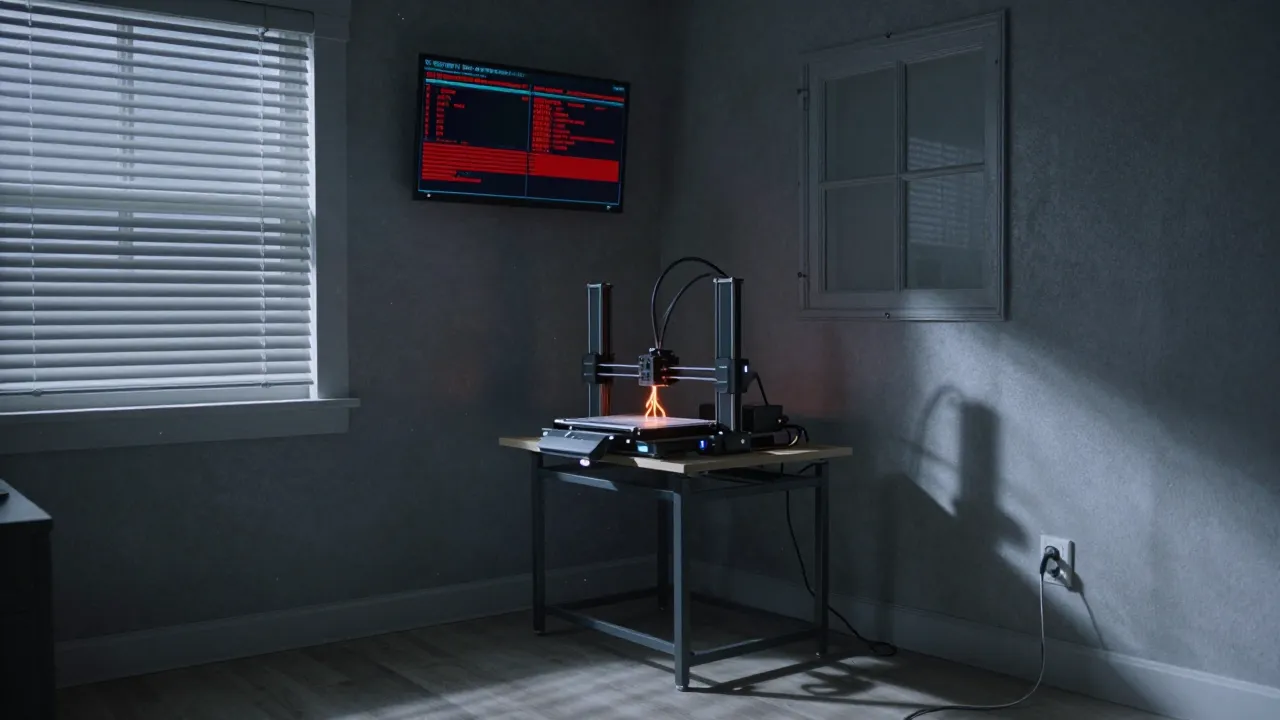
A California bill aims to mandate surveillance software in every 3D printer sold in the state, capable of inspecting everything the user attempts to manufacture at home. A silent shift from the presumption of innocence to the presumption of guilt, in the name of security.
A Permanent Spy in Californians’ Garages
The bill, known as AB 2047, would force manufacturers to integrate what its authors call “firearm blocking technology”: software designed to analyze every file sent to the printer and block any print job that a state algorithm deems suspicious. The principle is simple to state and dizzying in its implications: the machine installed in a garage or a classroom would no longer answer to its owner, but to Sacramento.
The Senate Public Safety Committee approved the measure on June 30, one step closer to its final adoption. The bill has already cleared two stages:
- passage by the Assembly in May;
- approval by the Senate Judiciary Committee in June;
- a favorable vote by the Senate Public Safety Committee on June 30, by five Democratic votes to one Republican vote.
It is now set to be reviewed by the Senate Appropriations Committee when the legislature reconvenes in the fall.
The Bill’s Author at the Helm… of the Committee Supposed to Protect Privacy
The institutional paradox is not without irony. The Democratic lawmaker behind the bill, Rebecca Bauer-Kahan, also chairs the California Assembly’s Privacy and Consumer Protection Committee - the very body tasked with protecting residents from permanent data collection. It is therefore under the authority of an official guardian of privacy that permanent, automated surveillance of a household object would be institutionalized.
A Technology That Doesn’t Work, According to Its Own Users
The technical mechanism meant to justify the law relies almost exclusively on solutions from a single company, Physna, whose representative testified before the committee in favor of the bill. However, industry practitioners flatly dispute its reliability. David Tobin, executive producer of the YouTube channel 3D Printing Nerd, summarized the situation for the lawmakers:
He then illustrated the conceptual absurdity of trying to read “intent” into simple geometry:
“There is a pen on your desks. It’s an object. It has no intent. No object has intent. We put it there. It could be a pen, it could be a tracheotomy instrument. It’s a tube.”
This technical confusion is not trivial: software unable to distinguish a weapon part from a medical part would, according to testimonies, end up blocking perfectly legal prints, including life-saving devices, simply due to shape resemblance.
A Supplier with Military and Security Ties
Physna’s profile raises questions about the true nature of the envisioned system. The company has announced a partnership with Palantir, the contractor specializing in data integration for administrations and security agencies, and has also won a contract with the Missile Defense Agency for its 3D data analysis work. A player built around the intersection of military and intelligence applications would thus find itself in the position of a guaranteed supplier for a consumer market, if the law mandates its technology in every equipped home.
A Measure Deemed Ineffective by Its Own Opponents
The sole dissenting voter on the committee, Senator Kelly Seyarto, summarized the opponents’ central argument: the law would punish legitimate users without hitting its declared target. Criminals, he argued, will buy their printers out of state or simply disable the software, while honest users would suffer what he described as:
His conclusion, delivered in committee, sums up the underlying tension between security logic and individual liberties:
“We need to go after those who break the law, not the technology they use, because they will continue to use it, whether or not you make new laws that affect everything else.”
Presumption of Guilt and the Technocratic Vanguard
The California bill illustrates a broader shift: a security logic that, historically confined to checkpoints (airports, borders, sensitive sites), is now expanding to ordinary everyday objects. A home 3D printer would become a permanent surveillance point, with every file sent becoming an object of a priori suspicion - a silent inversion of the principle that it is up to the prosecution to prove intent, not the machine to presume it.
California, a pioneer state in technology regulation in the United States, is acting as a laboratory here. What is being trialed there - the normalization of algorithmic control over a private object, under the guise of public safety - has the potential to spread to other Western jurisdictions, which traditionally keep a close eye on Californian precedents in digital regulation.
A Question That Goes Beyond 3D Printing
Beyond this specific case, the AB 2047 episode raises a fundamental question: how far can a government legitimately go in transforming a household object into a surveillance agent watching its owner, based on technology that its own users deem flawed? The matter has yet to be decided by the Senate Appropriations Committee in the fall - but the precedent itself has already been set.