
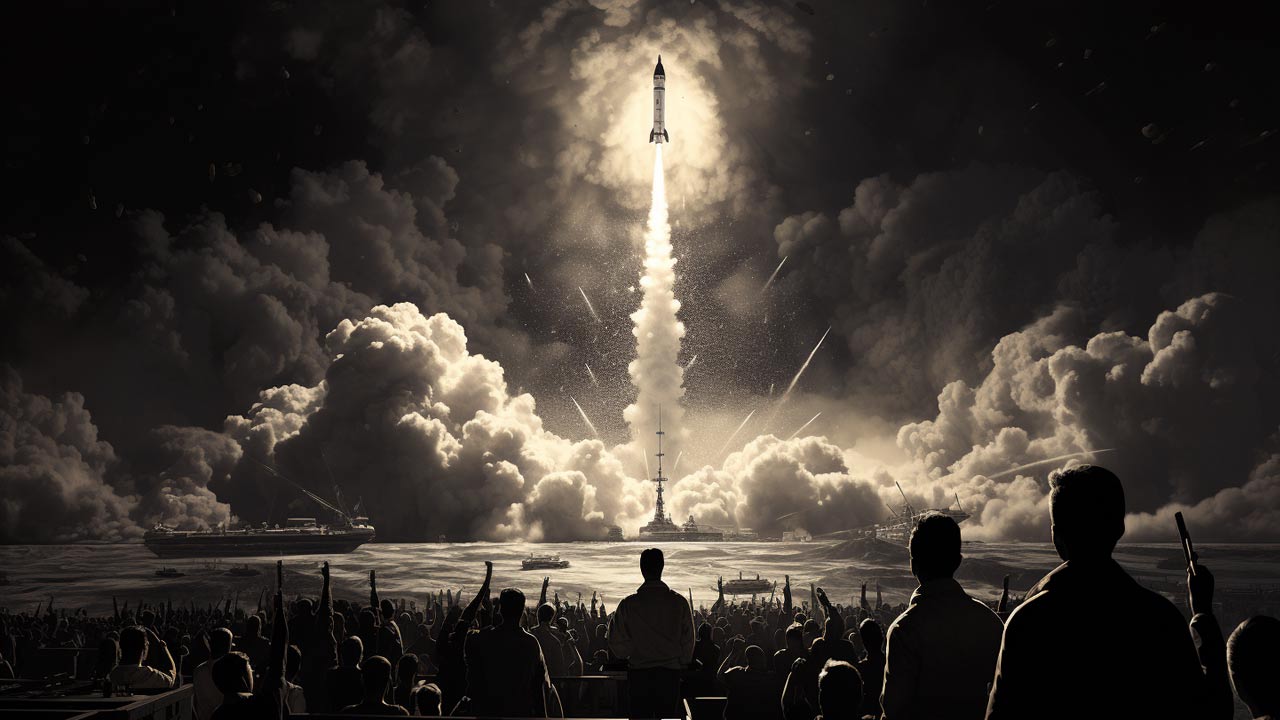
MOSCOW, 4 October 1957 – Yesterday, the Soviet Union achieved a historic feat that will remain etched in the annals of human history: the launch of the first artificial satellite, Sputnik, marking the official beginning of the space age. This small spherical object, weighing approximately 83 kilograms and fitted with four long antennas to transmit radio signals, was placed into orbit around the Earth, sending a shockwave across the world and inaugurating a new era of technological competition between the superpowers.
The launch of Sputnik was followed closely by millions of people across the globe, thanks to the radio signals it emitted. Those symbolic beeps, broadcast by the satellite, became the sound of scientific progress and spatial ambition. They not only confirmed the success of the mission but also served as tangible proof that the age of space exploration had begun.

The Soviet achievement immediately intensified the space race, particularly with the United States, which found itself both caught off guard and galvanised by this accomplishment. The American response was not long in coming, with immediate calls to intensify their own space programmes, in an effort not to fall behind in the race to space that had just begun.
The significance of the Sputnik launch far exceeds the purely technical feat. It symbolises the entry into a new era in which humanity’s frontiers extend beyond the Earth. The conquest of space is henceforth not only a scientific objective but also a major stake in national prestige and geopolitical power.
This event also marks a crucial turning point in the Cold War, underlining the technological and ideological competition between East and West. The capacity to place an object in orbit carries obvious military implications, reinforcing the urgency for nations to develop advanced space technologies.
As we mark this triumph of human ingenuity, the implications of the Sputnik launch will continue to be felt for years to come. This event represents not merely a scientific milestone; it is the prelude to an era of exploration, discovery, and perhaps even international cooperation in space, opening possibilities hitherto unimaginable for humanity.