
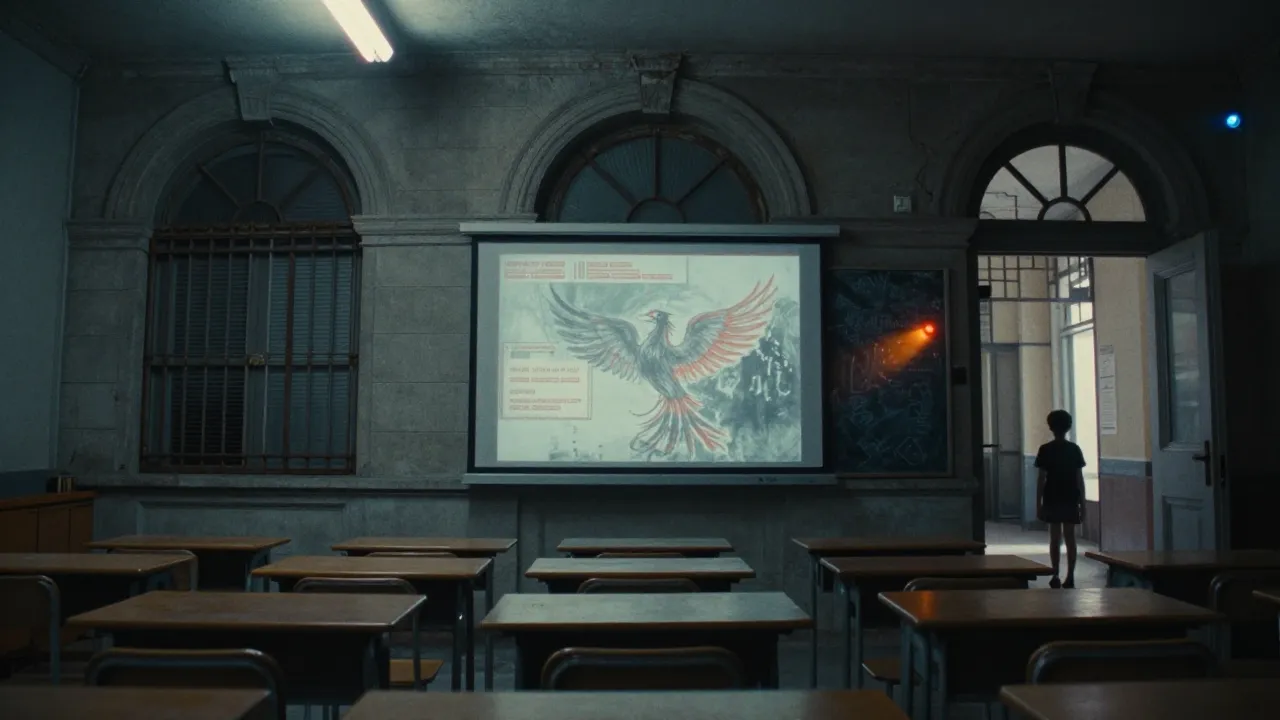
Imposed digitization without evaluation, lowered standards, administrative steering disconnected from the ground: year after year, the state school system seems to follow the scenario of an end that everyone sees coming, yet no one prevents.
A Death Written Through Reforms
In Latin American literature, there is a text that has become a narrative paradigm: Chronicle of a Death Foretold, by the Colombian writer Gabriel García Márquez, published in 1981 and crowned the following year with the Nobel Prize in Literature. The narrative device is famous: the entire village knows a man is going to be killed, everyone talks about it, yet no one acts to prevent it. Death is carried out in collective indifference, as if the outcome were written in advance and awareness of the danger were enough to excuse inaction.
This is the very mechanism that several teachers, unions, and parents describe today regarding schools: a documented, commented, and regularly denounced decline - yet one that is never truly halted by successive layers of administrative decision-making. The chronicle repeats itself, circulars pile up, and the educational institution seems to move toward its weakening with the same quiet fatality as Márquez’s village watching its destiny unfold.
Lowering Standards: A Recurring Observation
On the ground, the discourse converges: curricula have reportedly been watered down, subject requirements relaxed, and grade retention discouraged in the name of smoother enrollment management. From pedagogical meetings to class councils, teachers report a shared feeling:
The benchmarks that once structured learning - spelling, arithmetic, general knowledge - now seem negotiable, adjusted downward rather than upward in terms of the effort demanded of students.
This observation, widely echoed in public debate by teachers on the ground, inspectors, and parents, fuels a widespread concern: that of a school system progressively relinquishing its role of selection and knowledge transmission in favor of automatic promotion and doctored success statistics.
Forced Digitization, Without Prior Pedagogical Evaluation
Among the most contested transformations is the accelerated digitization of educational practices:
- the widespread adoption of digital media in the classroom, often decided at the central level;
- the deployment of tools and platforms without any publicly documented pilot phase;
- the gradual replacement of paper with screens, even for the youngest students;
- teacher training perceived as insufficient given the scale of the required changes.
Criticisms raised by teacher collectives and educational science researchers point to the same flaw: these digital reforms were allegedly launched without prior pedagogical impact studies, and without any serious measurement of their effects on concentration, memorization, or the acquisition of fundamentals. Technology has thus become an end in itself, imposed from above, rather than a tool serving a clearly defined educational project.
An Out-of-Touch Administration, Disconnected from Classrooms
The feeling of dispossession also affects how decisions are made. Many teachers describe remote management, produced by ministries and central directorates rarely seen in classrooms, where circular follows circular without ever matching the reality experienced by teaching staff: overcrowded classrooms, highly diverse student levels, and a lack of human resources.
This disconnection fuels a trust gap:
- between teaching staff on the front lines and the administrative layers designing the reforms;
- between stated objectives (equal opportunity, success for all) and the resources actually allocated on the ground;
- between institutional discourse and the daily experience of families, who are often helpless in the face of the changes imposed on their children.
Cultural Transmission: The Silent Stake
Beyond numbers and systems, what is at stake is the question of transmission. Schools have long been the place where a civilization perpetuates itself: they teach a language, a history, a shared literary and cultural heritage. When standards are relaxed, when digital technology replaces the patient reading of a book, when the administration imposes its reforms without listening to those who teach, it is this chain of transmission that weakens.
As in Márquez’s tale, the foretold death of the school system would not be the result of a sudden accident, but the culmination of a series of successive surrenders, known to all, yet never addressed at their root. It remains to be seen whether this chronicle will close on an admission of collective helplessness, or if it can still be rewritten - by those who, every day, hold the classroom.