

Since July 7, 2026, every new vehicle sold in the European Union must be equipped with an infrared camera pointed at the driver. A major technical and legal shift, enacted without any real public debate, raising questions about the boundary between road safety and the generalized tracking of behavior.
A Device Imposed by Technical Decree
The measure does not come out of nowhere: it stems from the European regulation GSR 2 (General Safety Regulation 2), officially Regulation 2019/2144, which has been phased in since 2022. The core device is called ADDW (Advanced Driver Distraction Warning), an “active attention monitoring” system relying on a camera positioned behind the steering wheel, tasked with analyzing the direction of the driver’s gaze and head position, as detailed by Reclaim The Net.
The timeline was set in several stages:
- since July 2022: initial GSR 2 obligations;
- since July 2024: ADDW becomes mandatory on newly approved vehicle types;
- since July 7, 2026: the obligation extends to all new vehicles placed on the market, as confirmed by Service-Public.fr.
In practice, the system triggers an audible and visual warning - reinforced by a vibration according to some sources - if the driver’s gaze leaves the road for more than 6 seconds between 20 and 50 km/h, or more than 3.5 seconds above 50 km/h.
Normalization Without Substantial Democratic Consultation
The process chosen by Brussels is striking in its method: such an intrusive modification of the relationship between citizens and their cars - a space previously perceived as private - was passed through a technical European regulation, without a referendum, without substantive national parliamentary debate, and without any prior public information campaign.
The former European Commissioner for Internal Market, Thierry Breton, defended the overall logic in these terms, quoted by Reclaim The Net:
« The EU is a world leader in general vehicle safety rules. We are ensuring that innovative technological solutions can be used to improve safety on our roads. »
An objective presented as consensual - the reduction of serious accidents - thus serves as a vehicle for an expansion of digital control that has never been the subject of an explicit collective choice. The magazine Auto Moto summarizes the tension in direct terms, calling the device:
« An intrusive surveillance system [that] is coming to new cars » and is « impossible to deactivate ».
Stated Safety, Questionable Traceability
The official argument relies on projected figures. The European Commission estimates that the entire GSR 2 safety package could prevent more than 25,000 deaths and 140,000 serious injuries by 2038, as part of the long-term Vision Zero goal, which aims to eliminate road deaths by 2050, according to figures reported by Reclaim The Net.
However, a notable ambiguity remains regarding the true nature of the device, according to the sources consulted:
- Reclaim The Net asserts that the system is “impossible to deactivate” and that it is “a legal condition of sale,” leaving no choice for the user;
- Service-Public.fr, conversely, specifies that the system “activates automatically at every start, but the user retains the freedom to deactivate it manually during their trip,” and assures that “the technology used complies with the GDPR and does not store any personal or biometric data.”
This discrepancy between sources supposedly describing the same regulation illustrates in itself the lack of clarity surrounding the measure: the general public has no clear, unambiguous information regarding their actual rights when faced with this camera installed by default in their vehicle cabin.
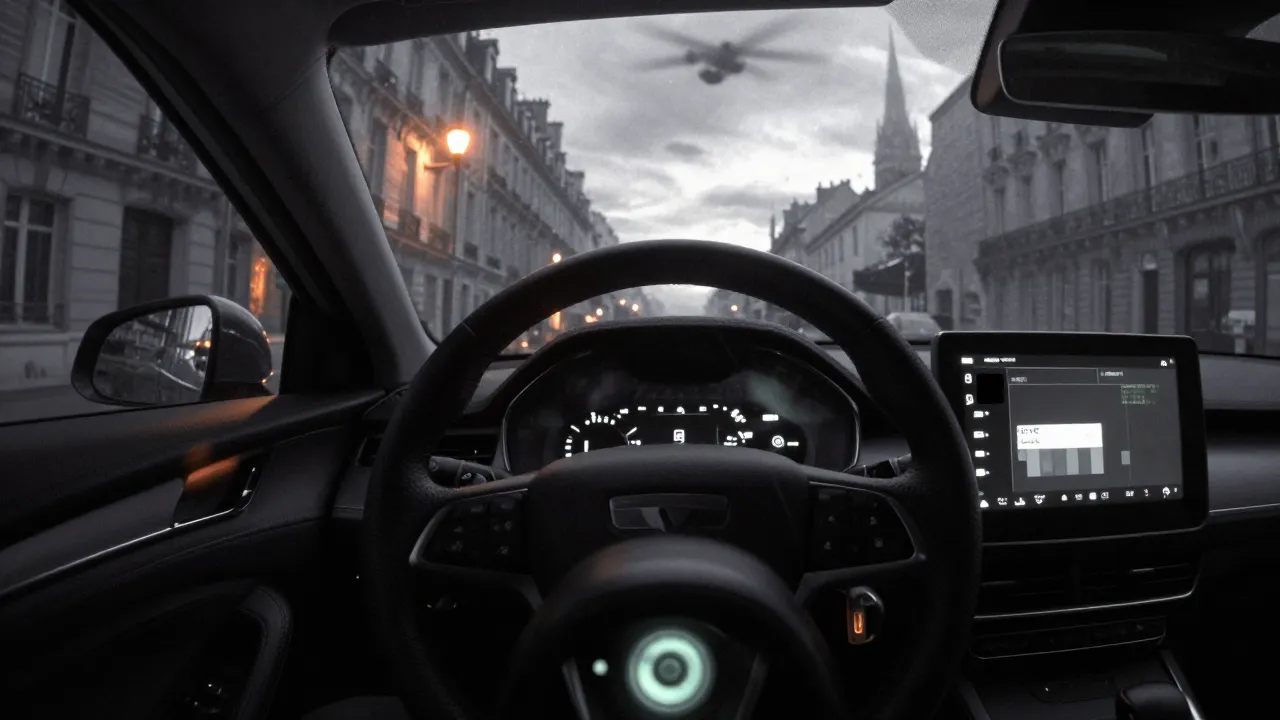
The regulation also establishes safeguards: a ban on facial recognition or biometric identification, and a ban on exporting data from the vehicle or transmitting it to third parties. However, Reclaim The Net describes these limits as mere “settings” that could be revised once the hardware is already installed in tens of millions of vehicles:
« Regulators who mandate the hardware today can expand its use tomorrow, and by then, the expensive and painstaking work of wiring a camera into every cabin will already be complete. »
A Gradual Expansion of the Scope of Control
The ADDW device is only one tier of a broader set of technical measures imposed by the same regulation, which also includes:
- autonomous emergency braking (AEB), already mandatory since 2024 for vehicle detection, now extended to detect cyclists and pedestrians;
- improved pedestrian protection, particularly against head impacts;
- an improved forward field of vision for light commercial vehicles.
According to Service-Public.fr, small series - fewer than 1,500 vehicles per year - and special-purpose vehicles remain subject only to the requirements already in force since Phase 2 in 2024 (emergency braking, lane-keeping assist, sign detection, cybersecurity). Vehicles already on the road are not subject to any retrofit requirements - the shift only affects new sales, but this flow will eventually renew the entire European vehicle fleet.
The Precedent That Matters
Beyond this specific case, it is the method that raises concerns: a camera pointed at the interior of the cabin, funded by the buyer themselves, is gradually becoming a manufacturing standard in the name of safety, without the question of its ultimate purpose - strictly limited road safety, or an additional building block of a generalized digital tracking ecosystem - ever being settled by a democratic debate worthy of the stakes. It remains to be seen whether current safeguards, such as the non-storage of biometric data and the ban on transmission to third parties, will withstand future regulatory revisions once the hardware is irreversibly installed across the continent’s vehicle fleet.