
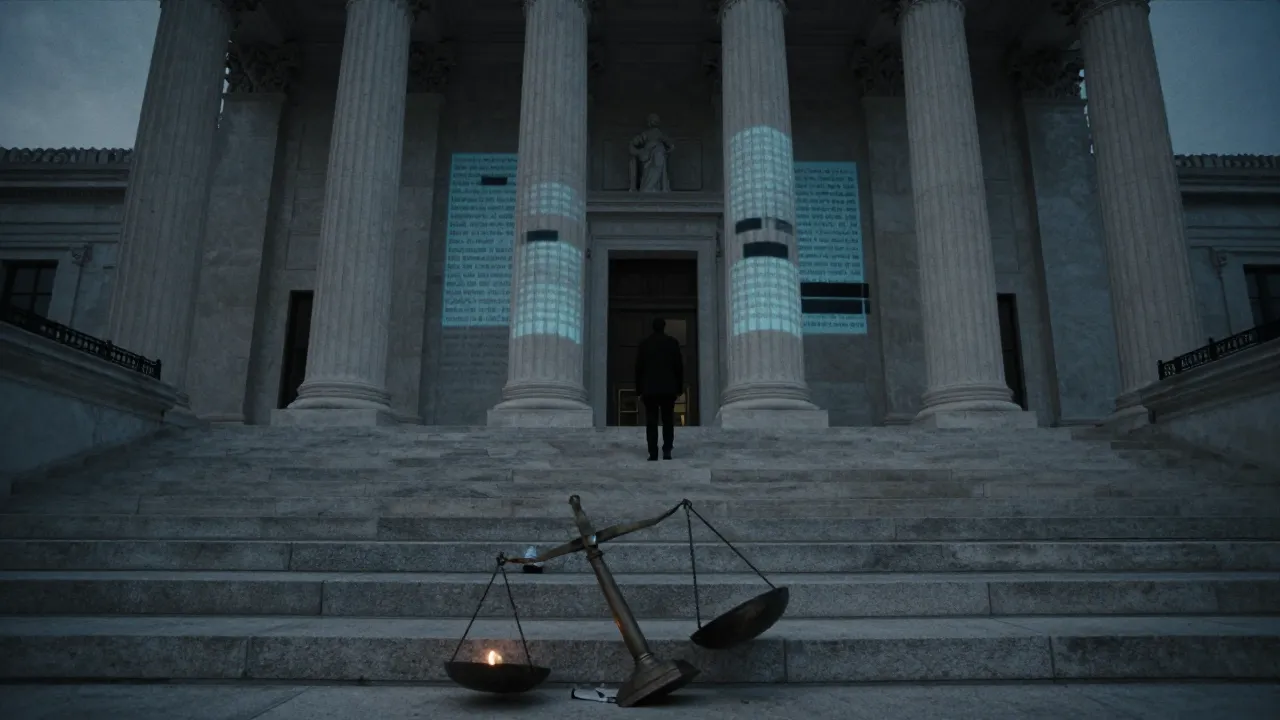
For the first time in Israel’s history, a government has openly proclaimed its intention not to submit to a decision of the Supreme Court. This unprecedented precedent raises, far beyond Tel Aviv, a fundamental question: in a formal democracy, who restrains power when power refuses to be restrained?
The Standoff: An Unprecedented Constitutional Rupture
The trigger is precise. By announcing that he would not comply with a Supreme Court decision regarding media control, Prime Minister Benjamin Netanyahu crossed a line that none of his predecessors had dared to approach. Le Monde describes the event as a “judicial coup,” quoting Israeli voices who see it as “the final nail in the coffin of democracy.”
Les Echos confirms the unprecedented nature of the rupture:
“For the first time in Israel’s history, the government has proclaimed its intention not to respect a Supreme Court ruling regarding media control, triggering a constitutional crisis.”
The mechanics of the standoff rest on a logic of deliberate and gradual defiance:
- The Supreme Court issues a binding decision regarding media regulation.
- The Netanyahu government publicly announces its refusal to comply.
- This proclamation transforms a legal disagreement into an open challenge to judicial authority.
- The constitutional crisis begins: no enforcement mechanism can compel an executive that refuses to obey.
It is precisely this procedural vacuum that makes the situation so serious. A democracy without an enforcement mechanism for judicial decisions against the executive is a democracy whose architecture relies on the goodwill of those in power - a goodwill that Netanyahu has just unilaterally withdrawn.
An Exportable Model: European Precedents
The temptation is not Israeli by nature. It is structural, and Europe already has several documented variations.
In Poland, the PiS (Prawo i Sprawiedliwość) government methodically reconfigured the Constitutional Tribunal starting in 2015, appointing favorable judges and challenging the legitimacy of decisions it disliked. The European Commission opened a procedure under Article 7 of the Treaty on European Union - a preventive mechanism against breaches of the rule of law - without managing to enforce an effective correction for several years.
In Hungary, Viktor Orbán reformed the judicial system as early as 2011-2012 to place loyalists at the head of oversight bodies, lower the retirement age of judges to force retirements, and create new administrative courts exempt from ordinary oversight.
These two trajectories share a common logic with the Israeli crisis:
- Electoral legitimacy used as a shield against any institutional criticism.
- Media control as a parallel lever to shape public opinion.
- Prior delegitimization of judges, presented as an unelected, out-of-touch elite opposed to the popular will.
- Gradual escalation - each line crossed prepares the next.
The convergence of these methods suggests less national coincidence than a shared repertoire, whose actors observe and draw inspiration from one another.
The Silence of Allies: When Geopolitical Solidarity Takes Precedence Over the Rule of Law
The Israeli constitutional crisis is unfolding under the gaze of Western partners whose reaction partly conditions its outcome. Yet this gaze is clouded by strategic interests that tend to neutralize any serious pressure.
The United States, Israel’s main ally and security provider, finds itself in a structurally contradictory position: supporting the Israeli rule of law would mean exerting public pressure on a government with which close military and diplomatic ties have been maintained. The Trump administration, which itself maintained a conflictual relationship with its own judicial institutions, is not in a credible position to demand from Israel what it challenged at home.

This paralysis of external allies reveals a systemic flaw: the mechanisms for guaranteeing the rule of law are almost exclusively internal. When the executive captures institutions, no supranational body has the necessary binding levers to reverse the trend - as the European Union has painfully experienced with Budapest and Warsaw.
Formal Democracy Facing Executive Capture
The structural question raised by the Israeli crisis goes far beyond its geographical context. It touches the heart of the problem of formal democracy: a regime can organize regular elections, maintain an appearance of pluralisme, and yet methodically proceed to neutralize all effective checks and balances.
Political scientists refer to this process as democratic backsliding or competitive authoritarianism: an authoritarianism that retains electoral forms while emptying oversight mechanisms of their substance. The characteristic tools of this capture are now well identified:
- Partisan appointments to constitutional and supreme courts.
- Reform of procedural rules to lengthen or block judicial delays.
- Pressure on the media to reduce critical coverage.
- Populist rhetoric designating judges as an unelected oligarchy opposing the people.
- Use of emergency procedures or states of exception to legislate without debate.
What distinguishes the Netanyahu case is the bluntness of the challenge: no longer a silent erosion, but a public proclamation of disobedience. This declared act constitutes a qualitative escalation - it is less of a drift than an assumed rupture.
A Lesson for European Sovereignists: Sovereignty is Not Impunity
The Israeli crisis offers a lesson that European sovereignist movements would be wrong to ignore. National sovereignty - the right of a people to govern themselves according to their own laws, on their own territory - is not synonymous with the impunity of the executive that claims to represent that people.
There is a dangerous confusion, sometimes deliberately maintained, between two radically distinct propositions:
- Legitimate proposition: a sovereign state has the right to define its laws, its borders, its institutional organization, without illegitimate external interference.
- Illegitimate proposition: an elected government can free itself from justice and checks and balances in the name of the popular will it claims to embody.
The first is the foundation of any serious national policy. The second is the very definition of elective tyranny. Netanyahu embodies this confusion today: he claims Israeli sovereignty to justify freeing his government from the Supreme Court of that very same State.
The European constitutional heritage - forged through centuries of struggle against royal arbitrariness, then against the totalitarianisms of the 20th century - rests precisely on the idea that power, even when elected, must be constrained by law. This is not a supranational technocratic invention: it is one of the deepest contributions of the Western legal and political tradition, from the Magna Carta to republican constitutions.
The real question raised by the Israeli crisis is therefore not: “Who is right, Netanyahu or the Supreme Court?” It is: in which direction does a democracy tilt the day a government decides that justice no longer concerns it? The answer to this question is not to be found in Tel Aviv. It is built - or unmade - in every capital that observes and chooses what lessons to draw from it.