
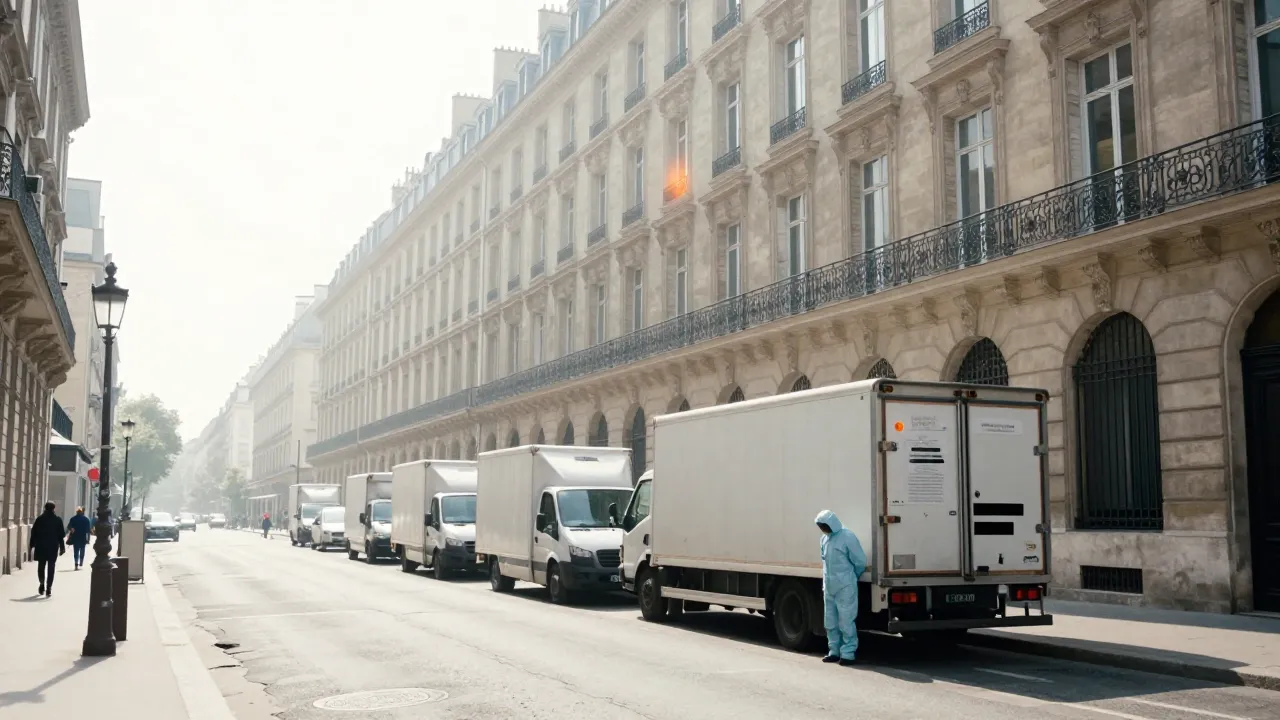
In just a few days, the June 2026 heatwave has killed more than 1,000 people beyond normal mortality rates in France, overwhelming Parisian funeral homes and once again revealing the deep flaws of a State slow to learn the lessons of its own crises.
A Brutal Health Toll, Confirmed by Authorities
Since June 24, 2026, Santé publique France has recorded more than 1,000 excess deaths compared to previous months. This figure, published in an initial official assessment and reported by Le Monde, represents a serious warning threshold. This excess mortality was observed over just a handful of days, in a country that has nevertheless had a national heatwave plan since 2003, specifically designed to prevent this type of tragedy.
Santé publique France describes the event as an “exceptional heatwave” and officially confirms the increase in deaths. The semantics are measured; the facts are not.
The comparison with the August 2003 heatwave naturally arises in public debate, even though the final toll of this 2026 episode has not yet been consolidated. In 2003, France recorded approximately 15,000 excess deaths over the entire heatwave period - a figure etched into institutional memory that led to the creation of the heatwave plan, the reform of warning systems, and the establishment of the “solidarity day.” Twenty-three years later, excess mortality is rising again from the very first days of a heatwave.
Overwhelmed Funeral Homes: The Invisible Logistic Collapse
Beyond the human toll, it is the logistical reality that is strikingly revealing. TF1 Info reports the words of Gautier Caton, a funeral director, who described on LCI “a saturation of funeral homes” in Paris and the Île-de-France region. Professionals in the funeral sector say they are “already exposed” to the wave of deaths, with body collection and preparation delays growing dangerously long.
This saturation is not an accident: it is the predictable consequence of an infrastructure sized for ordinary mortality, with no margin of resilience in the face of shocks. Funeral homes, crematoriums, and body transport services operate on a just-in-time basis under normal circumstances. When a heatwave multiplies deaths over a few days, the system immediately grinds to a halt.
This phenomenon had already been observed in 2003, when refrigerated trucks had to be requisitioned to cope with overcrowded morgues. The fact that it is happening again in 2026 raises a simple question: what have we built in twenty-three years to prevent this from happening again?
An Unprecedented Week of Heat in French Meteorological History
Météo-France, cited by TF1 Info, describes the past week as the “hottest seven-day period ever measured across France.” An absolute record in national meteorological history. This exceptional thermal intensity partly explains the scale of the excess mortality, but it cannot absolve public officials from questions regarding the country’s state of readiness.
A climate record is a fact. The resulting political and administrative question is distinct: in the face of a decades-long documented trend toward hotter and more frequent heatwaves, have investments in resilience kept pace?
Firefighters on Maximum Alert, an Aerial Fleet Under Scrutiny
The heatwave does not only kill through direct heat. It triggers or worsens forest fires, mobilizing human and material resources that are already under strain. Laurent Nuñez, the Prefect of Police of Paris, stated that firefighters are on “maximum alert” for fires, adding that he is “extremely worried,” according to TF1 Info. A fire also broke out in Villeneuve-lès-Avignon on June 15, 2026, even before the peak of the heatwave.
The question of the Canadair water bomber fleet and the equipment of civil security services regularly resurfaces in public debate during every heatwave summer. Available sources do not allow, at this stage, for precise figures on the current state of this fleet or the budgets allocated to it. What we do know, however, is that this subject is the focus of recurring parliamentary reports pointing to chronic underinvestment - without budgetary decisions having, to date, fully addressed the identified gaps.
Demographics as a Structural Amplifier
The vulnerability of France - and more broadly of Western Europe - to heatwaves is not just a question of infrastructure: it is also demographic. The elderly, particularly those living alone, represent the population most exposed to the lethal effects of heat. Yet, the rapid aging of European societies mechanically means that every future heatwave will strike an increasingly older, and therefore increasingly vulnerable, population.
The sources available for this article do not provide updated statistical data on the share of those over 75 in the excess mortality of June 2026. However, the profile of the 2003 victims - where the elderly represented the overwhelming majority of deaths - constitutes a structural precedent that has not been fundamentally altered by public policies over the last two decades. Nursing homes, unconditioned housing, the social isolation of the elderly: these are all documented realities that resurface with every heatwave.
Climate Instrumentalization or Governance Failure?
The political reflex during every disaster of this kind is to turn it into an argument in the climate change debate. This reading is not scientifically unsound, but it presents a specific political danger: that of shifting responsibility to a global and diffuse phenomenon, to the detriment of examining concrete and immediate failures of governance.
The point is not to deny that summers are getting hotter. It is to ask why, in 2026, twenty-three years after the 2003 health disaster, funeral homes are once again overwhelmed in a matter of days, why firefighters still lack sufficient equipment, and why heatwave plans struggle to protect the most vulnerable. These are questions of planning, budgets, and political priorities - areas where successive governments bear direct and measurable responsibility.
Invoking climate change alone allows officials to wrap themselves in the posture of a victim of a higher power. Analyzing administrative and budgetary failures, on the other hand, requires naming choices, trade-offs, and those responsible.
A Structurally Deficient Resilience
What the June 2026 heatwave reveals, beyond its immediate human toll, is the state of systemic fragility of a State that has progressively abandoned the logic of resilience in favor of just-in-time management. Hospitals, funeral homes, civil security services, urban cooling infrastructure: all of these systems operate without margins, without reserves, and without the capacity to absorb shocks.
This fragility is not a natural inevitability. It is the product of decades of underinvestment in State capacities, of budget rationalization applied to basic public services, and of a technocracy more concerned with macroeconomic indicators than with the robustness of vital infrastructure.
When the heat returns - and it will - it is the oldest, the most isolated, and the most destitute who pay the price for this unpreparedness. Not the decision-makers who, year after year, deferred the necessary investments. This asymmetry between those who suffer the consequences and those who make the decisions is, ultimately, the real political issue of the summer of 2026.
Sources: Santé publique France - Le Monde, live heatwave, June 28, 2026 - TF1 Info, June 27, 2026