Thirteen months apart, Moscow and Paris will have staged two rival visions of the global order. Between Red Square and the Champs-Élysées, the military parade is no longer a commemorative ritual: it has become the visual language of a power struggle that chancelleries no longer express in communiqués.
Red Square as a Propaganda Theater
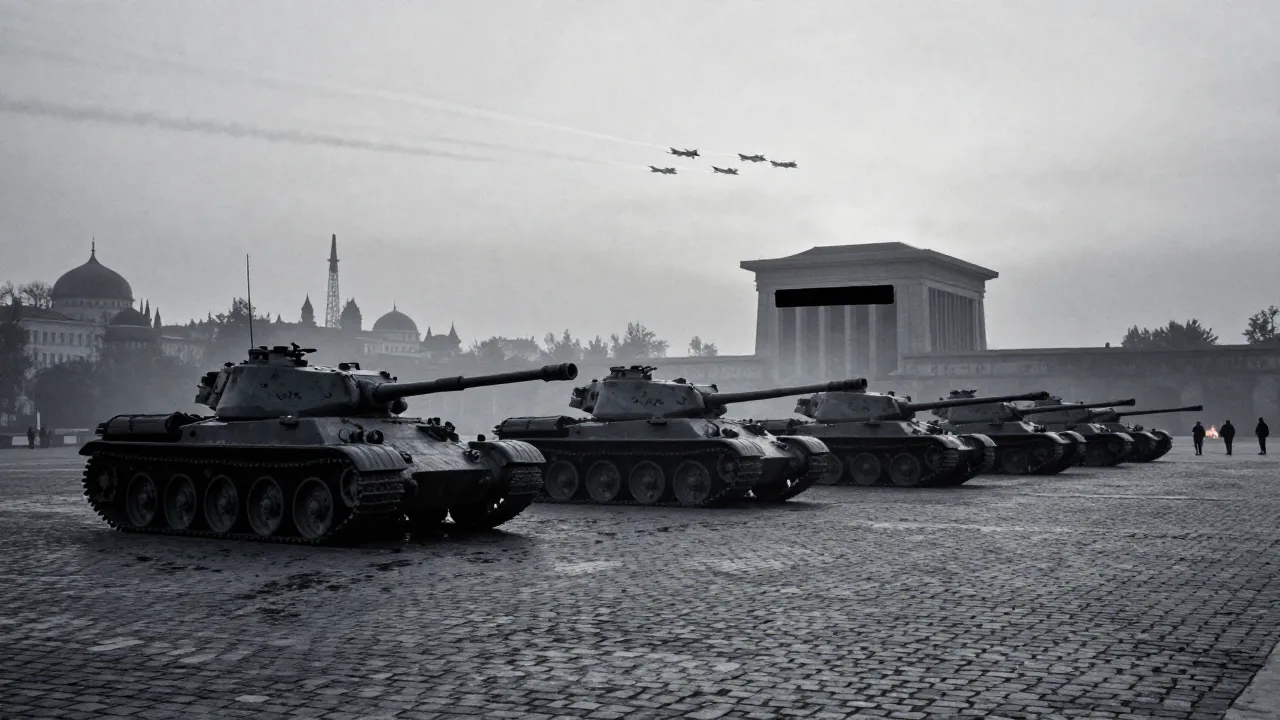
On May 9, 2025, for the eightieth anniversary of the victory over Nazi Germany, Vladimir Putin needed a masterstroke. According to Le Grand Continent, the Victory Day parade - set up by the master of the Kremlin as the “climax of his propaganda system” - mobilized:
- eleven thousand soldiers;
- T-90 tanks;
- S-400 defense systems;
- Iskander and Yars intercontinental missiles;
- for the first time, Orlan, Lancet, and Geran drones, used daily against Ukrainian cities.
Xi Jinping, guest of honor for four days, re-enacted the scene of “limitless friendship” proclaimed in 2022, which Putin sought to root in the “combat brotherhood” of World War II. Despite the ongoing war in Ukraine, twenty-nine foreign delegations were announced on the grandstand, including several heads of state from Africa.
« Every unit that parades, every leader present in the stands, every absence, every anthem played tells a truth that speeches conceal. »
This reading, put forward by Le Grand Continent, sums up what is at stake: the demonstration of force now precedes the diplomatic communiqué, and political iconography is once again a weapon in its own right.
Paris, July 14, 2026: The Staged Strategic Awakening
A year after Moscow, France is organizing its own parade, presented by the Ministry of the Armed Forces as showcasing:
- the strategic awakening of Europe;
- national cohesion;
- the operational credibility of the armed forces.
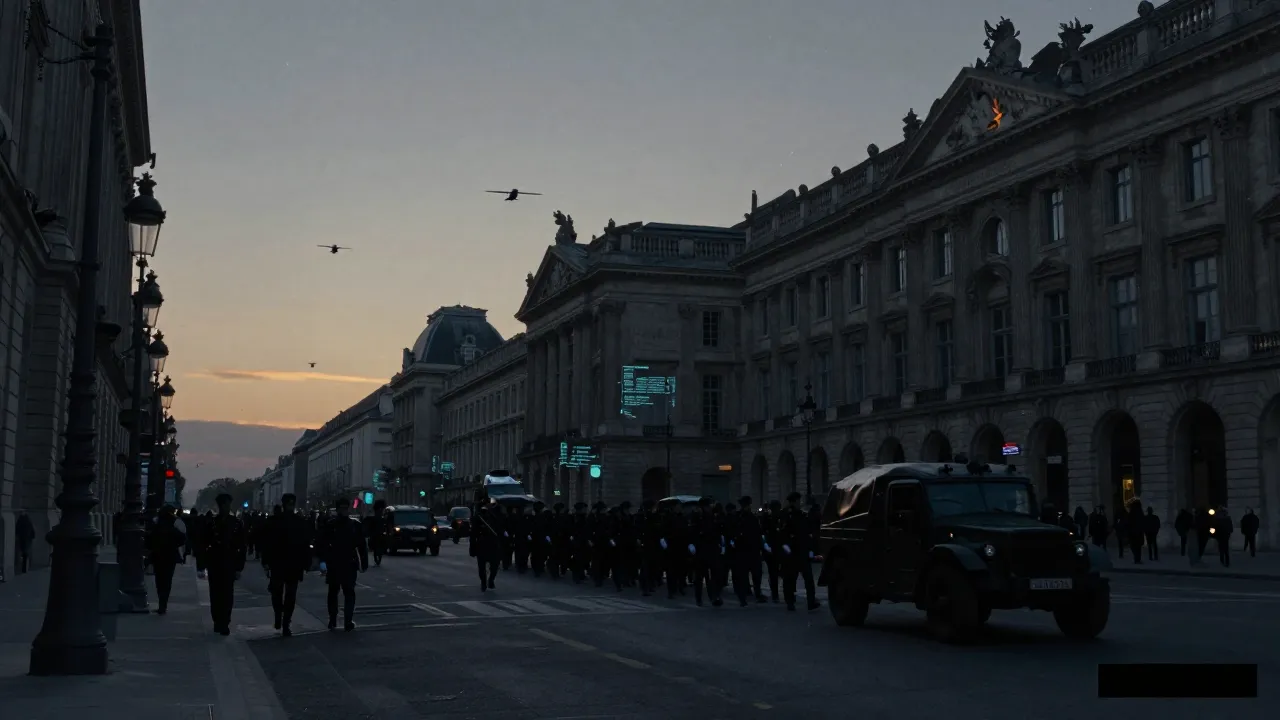
The official program, available on defense.gouv.fr, announces an “unprecedented educational approach aimed at outlining the reality of the modern battlefield,” with a dynamic interaction between ground troops and air support intended to illustrate the complementarity of the land, naval, and air components. The traditional parade - celebrated every year since 1880 - is intended this time to be an exercise in massive capability demonstration of the armed forces and internal security forces.
Notably, thirty-five countries of the Coalition of Volunteers - an initiative jointly led by France and the United Kingdom to guarantee a lasting peace in Ukraine after the end of hostilities - will be present on the Champs-Élysées, according to information from the Ministry of the Armed Forces.
Two Grandstands, Two Blocs, One Grammar of Power
The comparison between the two events implicitly outlines the reshaping of alliances mentioned by Le Grand Continent: on one side, a Russian-Chinese axis displaying its “combat brotherhood” in the face of Western sanctions; on the other, a coalition expanded to thirty-five nations seeking to gather what remains of Western unity around the Ukrainian issue.
This contrast illustrates a doctrinal shift rather than a simple republican routine:
- Moscow chose capability escalation - number of soldiers, new weapons systems, real-war drones - to project a power that the Ukrainian battlefield largely contradicts.
- Paris opts for an educational staging and an expanded coalition, seeking to demonstrate operational credibility rather than raw mass.
In both cases, the parade functions as a diplomatic language in its own right: who marches, who is absent, what equipment is shown - every detail is read by chancelleries as a political signal.
The French Position, Between Symbol and Strategic Fragility
France thus positions itself as one of the rare pivots capable of uniting a thirty-five-country coalition on the Ukrainian issue, alongside the United Kingdom. But this capacity for diplomatic mobilization is exercised in a context where Western influence, as described by Le Grand Continent, must now contend with reshaped imperial blocs and powers that no longer hesitate to display their strength even before opening negotiations.
The very choice of the theme - “Europe’s strategic awakening” - reflects an official realization: the continent can no longer settle for a spectator’s posture in the face of power dynamics that have once again become explicitly martial.
What the Grandstands Really Say
Beyond troop numbers and equipment, it is the presences and absences that speak. The delegations received in Moscow, the list of thirty-five countries invited to Paris, the diplomatic silences that accompany each parade: all of this forms an informal mapping of real alliances, sometimes far more reliable than multilateral summits themselves.
There remains a question that goes beyond the strictly military framework: in a world where the demonstration of force precedes the communiqué, what place does Western Europe intend to occupy - that of an actor capable of weighing in with its own strength, or that of a continent organizing its own staging without any longer controlling the overall script?