The château where Francis I signed the founding ordinance of French as the state language hosted, on June 27, 2026, an entire day dedicated to the Arabic language. A programmatic choice that crystallizes tensions around the cultural identity of French public institutions.
One Place, One History, One Paradox
The Château de Villers-Cotterêts is not just any monument. It was within its walls that Francis I signed, in 1539, the eponymous ordinance that imposed French as the language of law and royal administration - a founding act of national linguistic unity. It is precisely this location that President Emmanuel Macron chose to house the Cité Internationale de la Langue Française, inaugurated with a speech on the greatness and global reach of the French language.
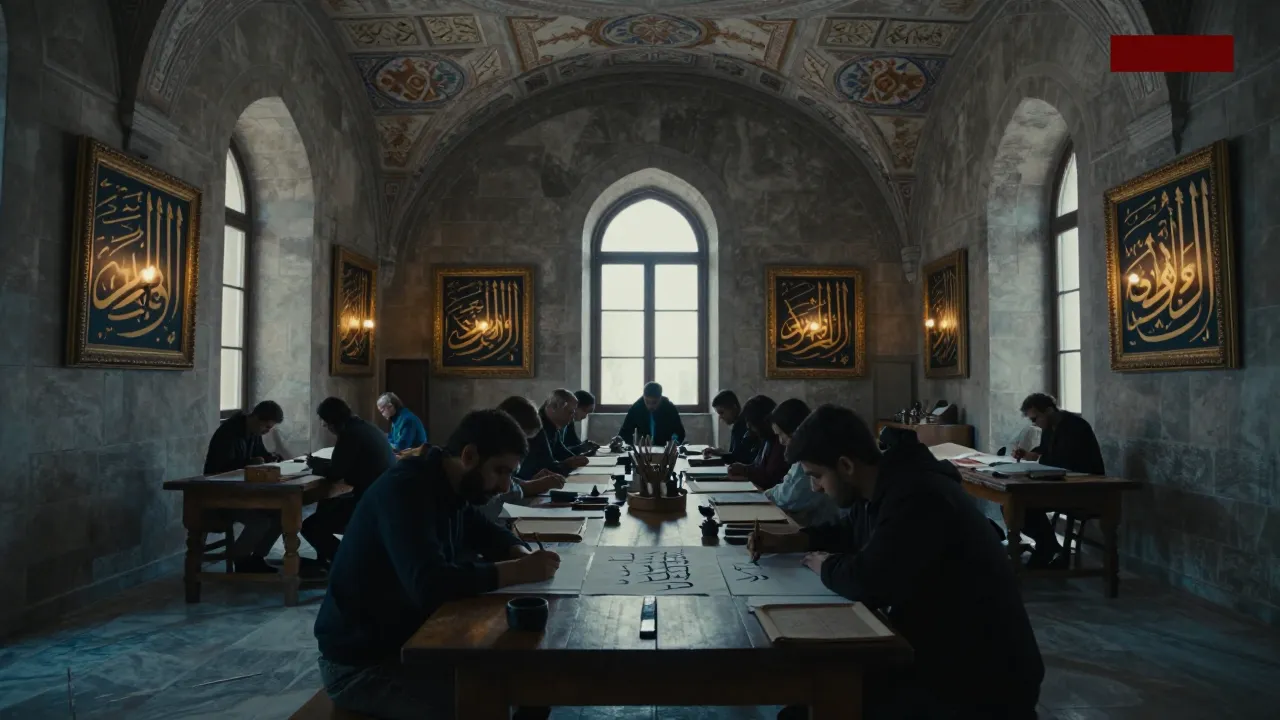
The symbol was powerful. The programming on June 27, 2026, was equally so, in a different register: introductory workshops in Arabic calligraphy, documentary screenings, debates, a theatrical performance - The Epic of Bani Hilal, directed by Palestinian director Bashar Murkus, performed in Arabic with French surtitles - and, to close, a concert by Camélia Jordana dedicated to the “Divas of the Mediterranean.” The day was officially titled: “Our Arabic Languages.”
The Director’s Justification: A Silent Redefinition of the Mandate
For Paul Rondin, director of the Cité Internationale de la Langue Française, the event was “obvious given the place of the Arabic language in France.” He clarified his position to the newspaper L’Union: “Our vocation at the Cité is to speak of the French language, but also of French languages, that is to say, languages spoken in France.” He also cited the figure of “nearly 4 million speakers” of Arabic in France to justify this choice.
This formulation warrants attention. The shift is semantic but structural: moving from “the French language” to “languages spoken in France” amounts to redefining the very scope of the institution - no longer the defense and illustration of a national language, but the plural mapping of linguistic practices present in the territory. Yet, this redefinition has not been the subject of any public debate, parliamentary vote, or official revision of the institution’s specifications.
This is not the first time the Cité has expanded its mandate in this way. According to Valeurs Actuelles, Paul Rondin had already justified the promotion of rap and slam poetry in the programming by a desire to avoid being left “only with the cultural bourgeoisie.” The logic is consistent: the institution systematically positions itself as a space for decentering the majority cultural referent, in the name of inclusivity.
The Instrumentalization of Sites of Memory
The question is not whether the Arabic language deserves attention - it is spoken by millions of people in the French-speaking world, from the Maghreb to the Middle East, and its history intersects with that of French in many ways. The question is one of location and interpretive framework.
Villers-Cotterêts is not a generalist cultural center. It is a national monument with a precise symbolic weight, whose stated purpose - by the State itself, through the mouth of the Head of State - was to celebrate and promote the French language. Organizing a day dedicated to another language there, without the French language being the central focus of the connection, constitutes a shift in meaning that supporters of the event downplay and critics perceive as a deliberate provocation.
This type of shift is part of a documented trend: the use of public cultural institutions as vectors of an identity politics that privileges the deconstruction of the national narrative over its transmission. Sites of memory - in the sense that Pierre Nora gave to this concept - are no longer merely preserved or celebrated; they are reinterpreted, sometimes turned against their own original meaning.
Reactions: The Silence of Some, the Irony of Others
The 450 seats for the closing concert, according to the same source, “quickly found takers.” But on social media, criticism poured in. “What if young people started by writing and speaking our language, French, correctly?” asked one internet user quoted by Valeurs Actuelles. Another, presenting himself as a resident of Villers-Cotterêts, ironized: “It’s Arabic all year round at the Cité; I know, I live here.”
Among political and institutional cultural circles, the silence is eloquent. No public reaction from the Académie Française has been noted. No parliamentary debate has been opened regarding the institution’s programming. Mainstream media did not treat the event as a controversy - it was the so-called “right-wing” or “sovereignist” press that carried the subject.
This asymmetry is itself significant. It reveals a form of implicit consensus within dominant cultural and media circles: questioning this type of programming would be perceived as an act of cultural closed-mindedness, or even xenophobia. Criticism is thus neutralized in advance, not by refuting the arguments, but by disqualifying those who formulate them.
Villers-Cotterêts, a Town and Its Contradictions
A geographical and political detail is worth noting. The town of Villers-Cotterêts, which has nearly 10,000 inhabitants, is described by Valeurs Actuelles as “the only commune in the department that was not retained by the National Rally during the last municipal elections.” This local context illustrates the distance that can exist between the orientations of a national cultural institution established in a territory and the sensibilities of the surrounding population - a distance that the Cité’s management seems little inclined to reduce.
The Deconstruction of Heritage as Policy
Beyond the anecdote, what is unfolding in Villers-Cotterêts is part of a broader movement that several European historians and intellectuals have begun to theorize: the transformation of public cultural institutions into instruments of a policy of symbolic “decolonization” of the national narrative. This policy proceeds through an accumulation of small shifts - a program here, a title there, a museographical reinterpretation elsewhere - none of which, taken in isolation, seems decisive, but whose cumulative effect is to progressively substitute one narrative for another.
The public funding of these institutions by the taxpayer raises a question of democratic legitimacy that political leaders - on both the left and the right - have so far carefully avoided addressing head-on. If the Cité Internationale de la Langue Française decides, on its own initiative and without an explicit mandate, to redefine its purpose to embrace all “languages spoken in France,” who decides, and in whose name?
The French language is not in danger because an Arabic play was performed on a Saturday in June in the Aisne department. It is perhaps in greater danger because the institutions supposed to defend it seem increasingly uncertain of the value of what they are tasked with transmitting - and this uncertainty is never brought up for debate.
Sources: Valeurs Actuelles, June 28, 2026; Centre des Monuments Nationaux; Château de Chambord - Wikipedia.