Sam Altman promises every American family a share of the wealth created by artificial intelligence. Behind this seemingly philanthropic gesture, the structure of technological power remains unchanged: concentrated, opaque, and more than ever in the hands of an oligopoly.
Anatomy of a Promise
The scenario repeats itself with troubling regularity. A Silicon Valley executive announces, in a grand burst of generosity, that the benefits of the technological revolution will be shared with the people. This time, it is Sam Altman, CEO of OpenAI, who is floating the idea of an “AI dividend” for Americans.
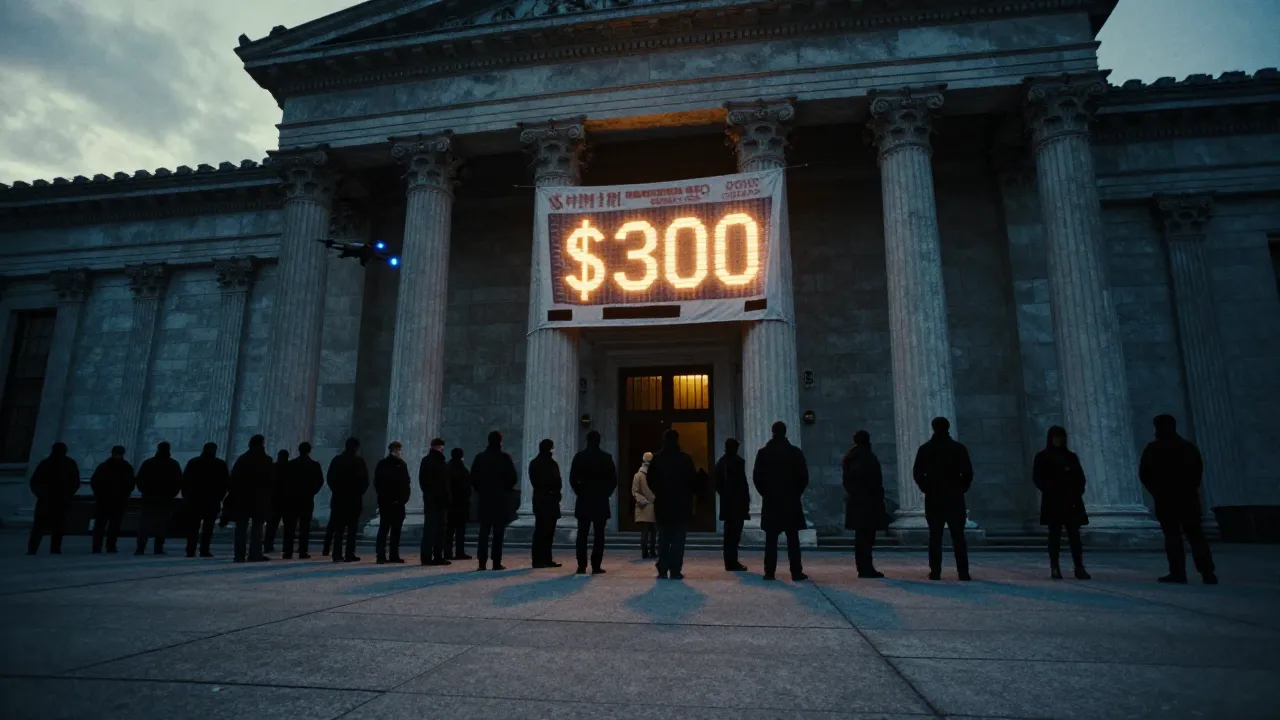
According to the Financial Times, Altman is in negotiations with the Trump administration to cede a 5% stake in OpenAI to the US government. The envisioned mechanism: revenues from this stake would fund a public trust distributing annual payments to American citizens - amounting, according to the calculations discussed, to about $300 per family.
The idea is not new. As early as 2021, Altman proposed a more radical version: that all companies exceeding a certain valuation threshold pay 2.5% of their market value each year into a national redistribution fund. In April 2026, OpenAI published a more streamlined version of this project in an industrial policy document, which closely resembles what Altman is reportedly discussing with the White House today.
« Sam Altman wants Americans to share in AI’s wealth. The proposal may be more revealing as a political narrative than as a policy plan. » — MIT Technology Review, July 6, 2026
The distinction is crucial: a political narrative, not a public policy plan. This nuance alone sums up the deep ambiguity of the announcement.
Who Really Owns the AI Rent?
To measure what a 5% stake in OpenAI would actually represent, we must first look at what the company is worth - and who owns it.
OpenAI is valued at $852 billion, according to Sciences et Avenir, citing ongoing negotiations. A 5% stake in this structure would therefore represent, on paper, a value of about $42.6 billion - a considerable figure, but one whose actual conversion into household dividends depends on a chain of conditions that have not yet been publicly defined.
The corporate web surrounding OpenAI provides a clearer picture of who is actually capturing the value:
- Microsoft: a historical partner since 2019, it has injected several billion dollars into the startup in exchange for exclusive access to its Azure platform. This exclusivity has since been lifted, but Redmond’s financial exposure remains massive.
- Oracle: OpenAI has just signed a $300 billion, five-year contract with the cloud giant to train and run its models. This contract is accompanied by the construction of data centers capable of delivering 4.5 gigawatts of power - equivalent to the consumption of a city of four million inhabitants.
- Broadcom: OpenAI has partnered with this semiconductor manufacturer to develop its first custom accelerator dedicated to generative AI, a deal valued at $10 billion, with production scheduled to begin in the summer of 2026.
- SoftBank and Gulf funds: involved in the Stargate project, announced in January 2026 with a $500 billion budget, but described by Café Tech as having “stalled due to lack of funding.”
This overview paints an unambiguous picture: the AI value chain is captured, both upstream and downstream, by a tight network of tech firms, investment funds, and industrial partners. The ordinary American citizen is nowhere to be found - except, perhaps, as the recipient of a symbolic check whose terms remain to be defined.
The Precedent of the Digital Revolution
Recent history counsels caution. In the 2000s, the internet revolution was also presented as a promise of economic democratization: universal access to information, new markets for small producers, disintermediation to the benefit of individuals. Twenty years later, the verdict is clear: a handful of platforms - Google, Amazon, Meta, Apple - concentrate the bulk of the value created, while workers in disrupted sectors face precarity and wage pressure.
The promise of the AI dividend fits into this same rhetoric of technological trickle-down: wealth created at the top would trickle down to the bottom. But the mechanism is not automatic, and recent history shows that it does not trigger spontaneously.
Several questions remain unanswered:
- Who decides the amount and timing of the payments? A public fund controlled by whom, under what governance rules?
- What legal obligation binds OpenAI to this promise, outside of an informal negotiation with the US executive?
- What happens if the valuation collapses - as has happened to many tech startups after going public?
- Who controls the data - the true strategic asset of AI - and under what conditions?
Altman, Player in a Broader Agenda
Sam Altman does not present himself as a simple entrepreneur. For several years, he has cultivated a positioning as an architect of the world to come, speaking in Davos circles, maintaining close relations with Washington, and publicly theorizing on the redistribution of wealth in the age of automation.
The proposal submitted to Trump fits into this posture: offering the US government a window into OpenAI’s capital is simultaneously - and herein lies the ambivalence - associating public power with the company’s legitimization, while keeping the bulk of operational and strategic control in the hands of its founders and private shareholders.
OpenAI proposes to sell up to 5% of its shares to a US public fund - in the context of a $1 trillion IPO being discussed in some financial circles. — @RenaudDekode, YouTube, July 2026
This dynamic is not without precedent in the history of capitalism: large dominant firms have often known how to integrate the state as a minority partner - granting it a large enough share to make it complicit, but not enough to allow it to exercise any real countervailing power.
The Symbolic Check as a Tool of Legitimation
This is perhaps the most serious political risk raised by Altman’s proposal: not that it is too generous, but that it is just attractive enough to neutralize any desire for serious regulation.
$300 per family - should the promise materialize - would represent a real sum for millions of struggling American households. But this marginal redistribution would do nothing to change the underlying structure:
- The intellectual property of AI models would remain private.
- User data would continue to be captured and monetized without fair sharing.
- Strategic decisions on the development, deployment, and uses of AI would remain concentrated in a tiny number of boards of directors.
- Jobs destroyed by automation would not be offset by an annual dividend of a few hundred dollars.
There is a political logic to this calculation: by making every citizen a micro-beneficiary, they are transformed into a micro-shareholder with a stake in the company’s prosperity. Criticism then becomes harder to voice - you don’t bite the hand that feeds you, even if it’s just a symbolic crumb.
Conclusion
Altman’s proposal is revealing, but not of what it claims to demonstrate. It does not say that OpenAI is ready to share power. It says that the concentration of technological power is now visible enough, and politically concerning enough, to demand a narrative response.

The real question is not whether American families will receive $300. It is who, in ten years, will control the cognitive infrastructures of our societies - and under what democratic rules, if any exist. A check is not an answer to this question. It is, at best, a way to postpone it.