With less than a year left in his term, Emmanuel Macron is committing France to an unprecedented military pooling with Germany, involving the Bundeswehr for the first time in a nuclear deterrence exercise - a structural decision that could tie his successor’s hands.
A Historic First Finalized in Brühl
Following the Franco-German Council of Ministers held on Friday, July 17, at Augustusburg Palace in Brühl, Emmanuel Macron and Chancellor Friedrich Merz formalized what Valeurs actuelles describes as a “major strategic step”: for the first time in its history, the German army will participate “during the course of the year” in a French exercise linked to nuclear deterrence.
The Christian Democratic chancellor announced it himself on X, in a phrasing that sets the tone for the ongoing rapprochement:
“Germany and France are deepening their defense cooperation. We are strengthening European deterrence. Starting this year, we will participate in a nuclear exercise of the French forces.”
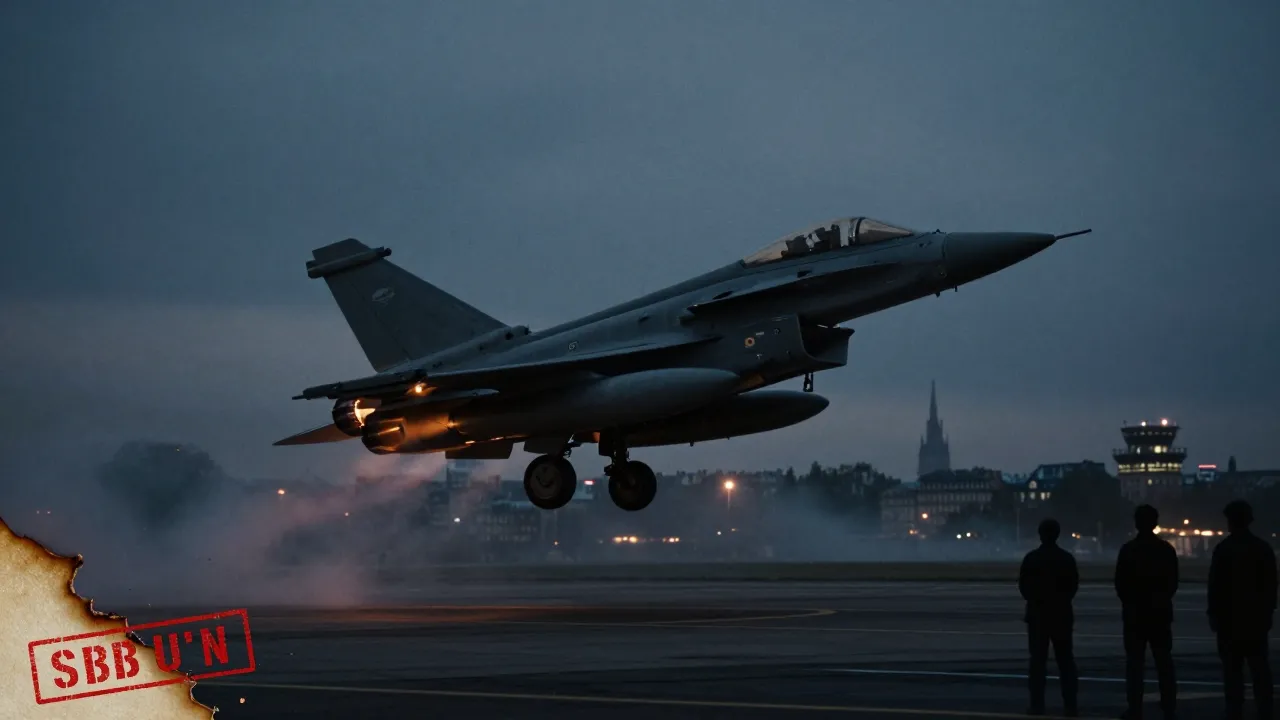
This announcement, also reported by Le Figaro, is accompanied by a second, equally symbolic measure: the upcoming deployment of a Rafale from the French Strategic Air Forces alongside the German army.
”Strategic Intimacy”: What Exactly Are We Talking About?
For both leaders, these announcements are intended to give substance to a shared ambition: building what they call a “European deterrence.” Emmanuel Macron went further by speaking of a “strategic intimacy” destined to redefine the Franco-German relationship, which, according to him, involves:
- joint exercises;
- joint partnership elements;
- the clear objective of “creating uncertainty for our adversaries.”
The vocabulary chosen - “advanced,” “extended,” “European” deterrence - is not neutral. According to a brief from Vie publique, the concept of “advanced deterrence” has already constituted, since the beginning of the year, a documented evolution of French nuclear doctrine. The Brühl episode is therefore part of an ongoing trajectory, rather than an isolated gesture.
Furthermore, this movement is not limited to the Franco-German couple: Valeurs actuelles reports that Norway has also joined this architecture established by Paris, a sign of a gradual expansion of the scope of French deterrence to other European partners.
A National Doctrine, an International Exercise: What Coherence?
The fundamental question raised by this sequence lies in its very nature: French nuclear deterrence historically rests on a principle of total independence of decision-making, the famous “ultimate sovereignty” of the Head of State, who alone is authorized to launch a nuclear strike. Having an ally - even Germany - participate in an exercise linked to this deterrence inevitably raises questions about:
- the exact nature of this participation (observation, planning, operational integration?);
- the reversibility of such a commitment for a successor who might not share the same strategic orientation;
- the coherence with official French discourse on deterrence, which traditionally emphasizes its strictly national character.
On this last point, the official declaration of the President of the Republic on nuclear deterrence, published by the French Ministry of Foreign Affairs, sets the doctrinal framework into which this new initiative fits - or with which it breaks.
A Timeline That Raises Questions
The most commented-on aspect of the announcement is its timing. Emmanuel Macron is formalizing this commitment at a time when his mandate is drawing to a close, and when Valeurs actuelles highlights that the hypothesis of a Marine Le Pen victory in 2027 “is entering calculations on both sides of the Rhine.”
In other words: the decision to pool a portion of French deterrence doctrine with Germany comes precisely at a time when the outgoing executive will no longer be in a position to bear its political consequences or alter its trajectory. A successor wishing to roll back this Franco-German “strategic intimacy” would have to do so at the cost of a diplomatic rift with Berlin - a scenario that, in effect, reduces their room for maneuver.
This way of locking in a major strategic direction at the end of a term, without broader parliamentary debate or electoral consultation on the matter, is part of a recurring pattern in the final years of the presidency: locking in through faits accomplis what democratic alternation could, in theory, call into question.
Extended Deterrence or Dilution of Sovereignty?
The debate over a “European nuclear umbrella” is not new, but its nature is changing as concrete commitments - joint exercises, cross-deployments, alliances extended to Norway - replace declarations of intent. Two interpretations clash:
- that of the French executive, which presents this pooling as a strengthening of deterrence on a continental scale in the face of shared threats;
- the more critical view, which sees it as a gradual dilution of a central attribute of French sovereignty - nuclear weapons - in favor of a coalition logic whose exact terms largely escape public debate.
The distinction between these two interpretations is not merely semantic: it determines whether France remains the sole master of its deterrence, or whether it becomes, de facto, a shared instrument whose use and doctrine will henceforth be co-constructed with foreign partners.
What the Future Holds
The exercise announced for 2026-2027 will constitute a first concrete test of this “strategic intimacy.” Its precise nature, the degree of actual involvement of the Bundeswehr, and how the next occupant of the Élysée chooses to align - or not - with this trajectory will show whether the foundation of French doctrine remains national or if it is shifting, in small increments and without a vote, toward a continental architecture on which the French public has not been formally consulted.