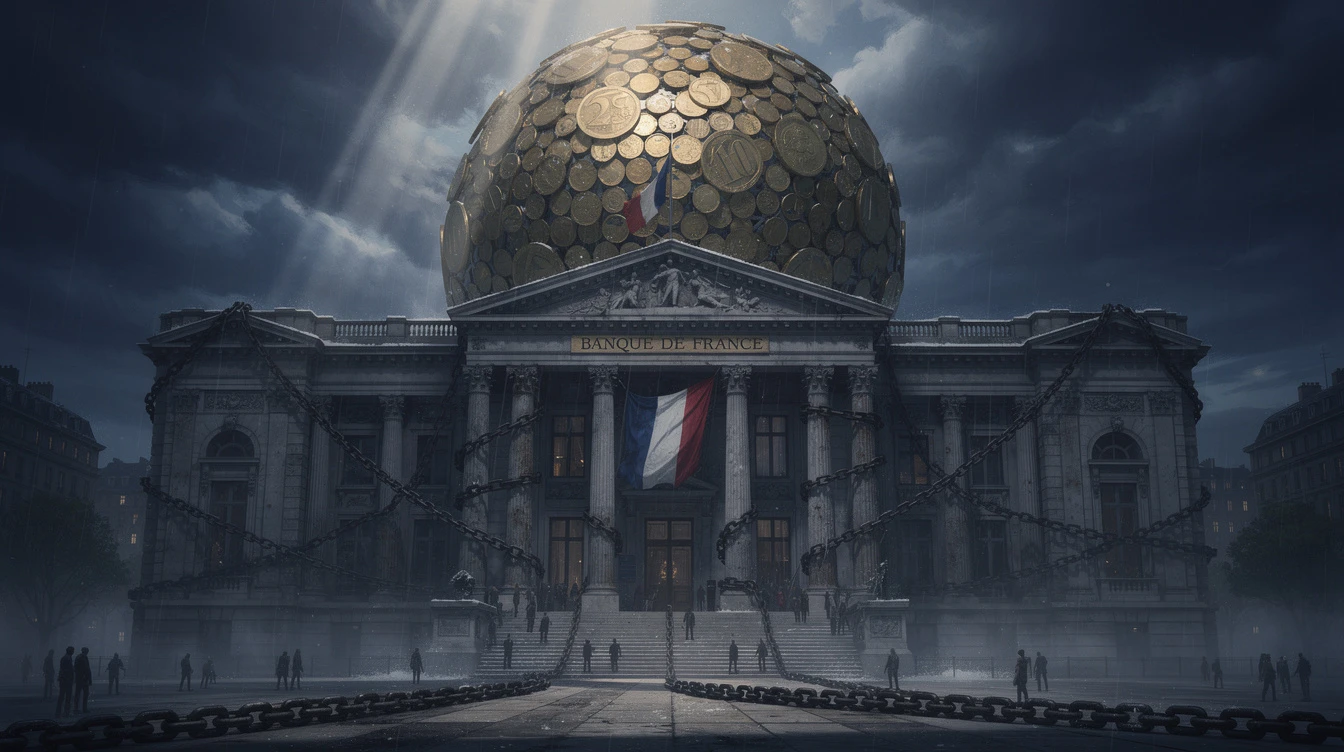
France’s debt now exceeds €3.2 trillion. At the turn of the 2000s, when I was twenty, it stood at around €750 billion. In twenty-five years, it has been multiplied by more than four.
People will tell you it’s a crisis, bad luck, an unforeseeable chain of events. That’s false. It isn’t a crisis. It’s a decision - repeated, generation after generation, by people who knew exactly what they were doing. And at the heart of this story sits a law, passed on 3 January 1973 in general indifference.
But so no one can accuse me of bending the facts, I’m going to tell this story precisely, dates included. Because the simplified version that circulates everywhere is wrong on one point - and the truth is actually even more damning.
The mechanism, explained to my daughter
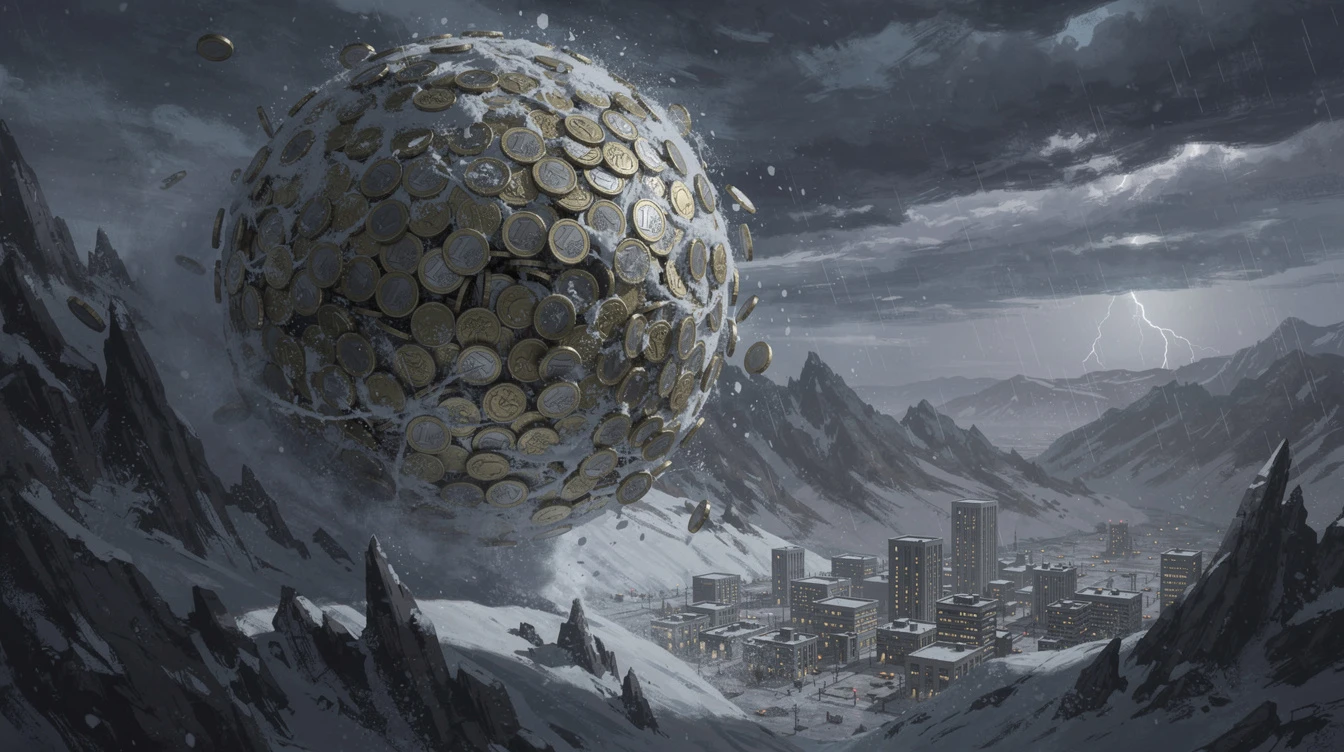
When the State spends more than it earns, it borrows. On that loan, it pays interest. And when it has to borrow again just to pay the interest on previous loans - which is what France has been doing for decades - the debt starts to grow on its own. This is called the snowball effect, or compound interest. Over fifty years, it’s something the human brain struggles to picture: it doesn’t add up, it multiplies.
In 2025, France paid roughly €54 billion in interest alone. That’s the equivalent of the entire national education budget. €54 billion that doesn’t build a school, doesn’t train a doctor, doesn’t invest in a factory. It flows into the accounts of creditors: investment funds, insurers, banks - French and foreign.
Hence the simple question: why does the State pay interest to fund itself, instead of funding itself directly?
The real timeline (and why “1973” isn’t enough)
Here’s where you have to be precise, because this is where most accounts go off the rails.
Before 1973, the State could fund itself directly from the Banque de France, at zero or near-zero rates. But already in a capped way, by agreement.
On 3 January 1973, under President Georges Pompidou, Law No. 73-7 reformed the statute of the Banque de France. Its famous Article 25 framed and capped this direct financing. Note carefully: it did not abolish it. Advances to the State were still possible. It was a first turn of the screw, not the closing of the tap.
The real lock came twenty years later. The Maastricht Treaty (signed in 1992) flatly prohibits the financing of a State by its central bank - that’s Article 123 of the European treaties. The French law of 4 August 1993 made the Banque de France independent and wrote the same prohibition into our own law. The whole thing took effect on 1 January 1994.
That’s when - in 1994, not 1973 - the tap was shut for good. From that point on, the State has no choice: for every euro it overspends, it must go and borrow it on the private financial markets, at rates set by players whose first interest is not that of the nation.
I insist on this precision, because it doesn’t weaken me - it strengthens me. No one can reply, “that’s false, in 1973 advances still existed.” Yes, they existed. The shift happened in two stages: 1973 opens the door, 1994 locks it.
Pompidou, Rothschild - and the real target
Why this first turn of the screw in 1973? To understand it, you have to know that Georges Pompidou, before politics, was general manager of the Rothschild bank. That’s a verifiable fact, not a theory. It’s what led people to nickname this text the “Pompidou-Rothschild law.”
I say it plainly, because it’s my signature: this is not a plot by a family, a group, or a religion. That would be an analytical error, and above all a way of missing the real target.
The real target is a system: revolving doors between political power and private finance. Pompidou the banker turned president is one example. Emmanuel Macron - also a former Rothschild banker - is another, fifty years later. The continuity is striking, and it goes far beyond any single name.
The real question runs deep: who has the right to create money, and for whose benefit? Before, the community kept part of that power, through its central bank. After 1994, that power was transferred entirely to the market.

The argument no one wants to hear: “quantitative easing”
Here’s the point that dismantles the official justification. The whole thing was locked down “to avoid inflation” - the idea being that a State which creates money for its spending always ends up letting it spiral.
Except that from 2008 to 2022, the central banks - the ECB included - created trillions of euros and dollars out of thin air to buy back debt. That’s quantitative easing. And for fourteen years, inflation stayed below 2%.
In other words: we forbid the State from funding itself through its central bank “because it would create inflation”… while that very same central bank creates money on an industrial scale without triggering the dreaded inflation. The justification no longer holds up as stated.
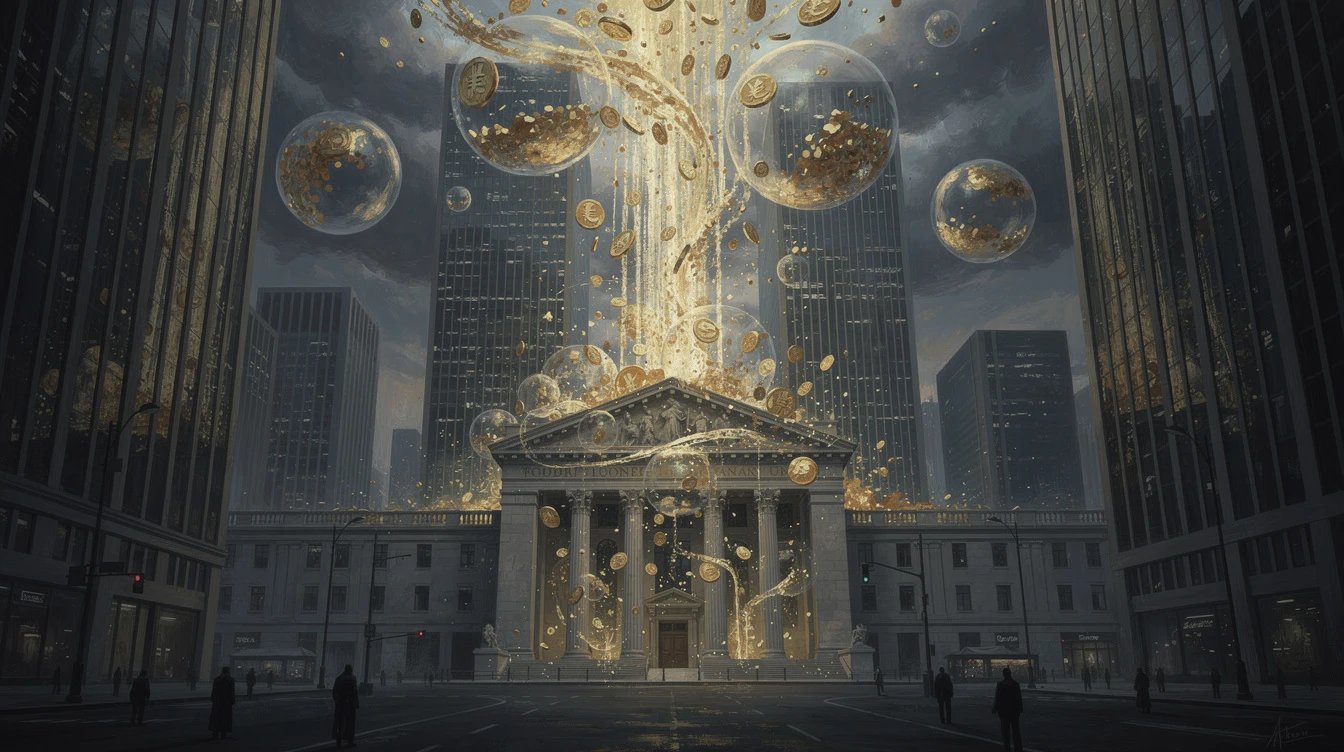
Worse: look at the actual circuit. The State issues a bond → a bank buys it (and takes its margin) → the central bank buys it back from the bank. The money ends up at the central bank anyway, but we’ve inserted a private intermediary that skims its commission along the way. We banned the straight line in order to take a detour that pays the financial sector. That’s exactly the sleight of hand no one ever explains to you.
Let’s be honest all the way
To stay credible, two caveats I fully own.
First, “we hand billions to the banks” is true for the intermediation rent - that undue commission. But a large share of the interest also rewards the savings of French people themselves: your life insurance, your pension funds hold the State’s debt. It’s not just “the banks” in the caricatured sense.
Second, inflation did come back in 2022-2023. The risk, then, wasn’t pure fiction - it was mainly deferred: all that money first inflated asset prices (the stock market, real estate), enriching those who already owned them, before finally reaching consumer prices. That, too, is a distribution scandal, and it weighs as much as the first.
That leaves my estimate, which I put forward as a conviction and not an established fact: since the 1980s, the cumulative interest burden runs, according to various analyses, into the trillions. Had France kept the ability to fund part of its deficit at zero rates, its debt today would be on a completely different scale than its €3.2 trillion. No one can calculate it precisely - too many variables. But the mere fact that this question is so rarely asked in the media, the governing parties and the elite schools tells me something about who benefits from it not being asked.
It’s not a conspiracy. It’s a choice.
Here’s where I land, and it’s the important thing.
It’s not a secret conspiracy. It’s a political choice presented as a technical necessity. A choice that prioritised price stability and European integration - at the cost of a very real interest burden for the taxpayer, and a rent handed to financial intermediation. It could have been done differently. Other arrangements existed, and still exist on paper.
Men made this decision in our name, without a referendum, without debate, without asking our opinion - and they knew its scope, or should have. Then, generation after generation, the political class used debt as a substitute for reform and lucidity. Out of comfort. Out of electoral calculation. Out of the absence of any counter-power.
We are the pivotal generation. Not because collapse is written - societies are resilient. But because the window in which we can still choose our trajectory is closing.
That’s why I’m writing Sons of Prometheus. Because a work of fiction that warns you five years ahead - with facts, exact dates, and a voice unafraid to name things - is still useful. And because the first step to not repeating a mistake is to understand exactly how it was made.
↓ The full transmission - data, sources, excerpts from the novel - at sons-of-prometheus.org.